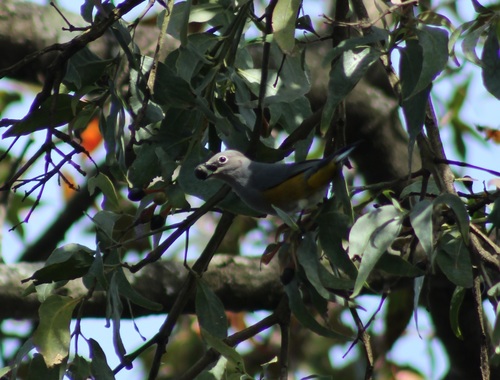
Northern Wheatear vs Grey Silky-flycatcher
Oenanthe oenanthe versus Ptiliogonys cinereus
Play a quiz with Northern Wheatear and Grey Silky-flycatcher
Northern Wheatear
Grey Silky-flycatcher
In short
The Northern Wheatear and Grey Silky-flycatcher are distinct in both appearance and habitat. The Wheatear is a ground-dwelling bird with a distinctive white rump and tail pattern, while the Silky-flycatcher is arboreal with a sleek, silky appearance and lacks the Wheatear's tail markings. Their habitats rarely overlap, with the Wheatear favoring open tundra and the Silky-flycatcher preferring montane forests.
Identification tips
1. Tail Pattern: Look for the Northern Wheatear's white rump and black tail with a T-pattern. 2. Habitat: Note the habitat; Wheatears are in open areas, Silky-flycatchers in forests. 3. Behavior: Wheatears are ground-dwellers; Silky-flycatchers are tree-perchers. 4. Size and Shape: Wheatears are smaller and more compact; Silky-flycatchers are larger and sleek. 5. Vocalization: Listen for the Wheatear's melodious song if unsure.
Size
Northern Wheatear is generally smaller and more compact compared to the larger, more elongated Grey Silky-flycatcher.
Plumage
Northern Wheatear has a distinctive white rump and black tail with a T-pattern, while the Grey Silky-flycatcher is uniformly grey with a silky sheen and lacks the Wheatear's tail pattern.
Behaviour
Northern Wheatear is often seen on the ground, hopping and flicking its tail, whereas the Grey Silky-flycatcher is more arboreal, often seen perched in trees.
Habitat
Northern Wheatear inhabits open areas like tundra and rocky landscapes, while the Grey Silky-flycatcher is found in montane forests and wooded areas.
Voice
The Northern Wheatear has a varied song with melodious phrases, while the Grey Silky-flycatcher's vocalizations are less documented but include soft, whistled notes.