Western Thornbill vs Buff-rumped Thornbill
Acanthiza inornata versus Acanthiza reguloides
Play a quiz with Western Thornbill and Buff-rumped Thornbill
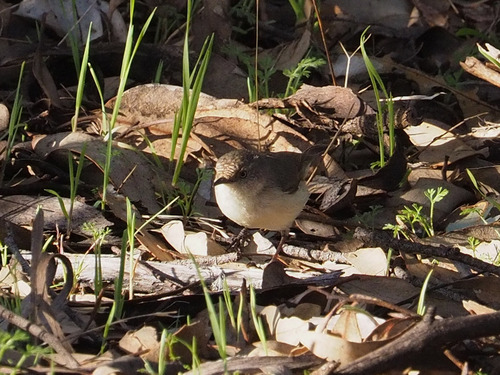 Western Thornbill
 Buff-rumped Thornbill
In short
The most reliable way to separate Western Thornbill from Buff-rumped Thornbill is the presence of a distinctive buff-colored rump and a broad blackish tail band with a pale tip on Buff-rumped Thornbill, which is absent in Western Thornbill. Western Thornbill is generally more brownish overall, with a grayish-brown cap and back, and lacks any obvious rump contrast. Both species are similar in size and shape, but their underparts and rump coloration are key in the field. Buff-rumped Thornbill also shows white irises as an adult, while Western Thornbill's eye color is not noted as distinctive. Habitat can help: Western Thornbill is restricted to southwestern Australia, while Buff-rumped Thornbill is found across eastern and southeastern Australia.
Identification tips
- Buff rump (Buff-rumped only): Look for a clear buff-colored rump patch, especially when the bird flicks its tail or in flight. Western Thornbill never shows this feature.
- Tail pattern (Buff-rumped only): Buff-rumped Thornbill has a broad blackish tail band with a pale tip, visible when the tail is spread. Western Thornbill's tail is plain brownish with no strong pattern.
- Overall tone: Western Thornbill is more brownish above and below, with a grayish-brown cap and back. Buff-rumped Thornbill is plainer greenish-brown above and paler yellowish below.
- Underparts: Western Thornbill has a creamy pale belly; Buff-rumped Thornbill is very pale yellow below. This can be subtle but is useful in good light.
- Iris color (adults): Adult Buff-rumped Thornbills have white irises, while juveniles have dark eyes. Western Thornbill's iris color is not distinctive. This mark requires close views.
- Group size and behavior: Buff-rumped Thornbill often forages in large, noisy groups and is highly acrobatic, sometimes hanging head-down. Western Thornbill is less often in such large, vocal groups.
- Flight style: Buff-rumped Thornbill shows undulating flight, typical of thornbills, but this is not unique enough to separate from Western Thornbill.
- Habitat and range: Western Thornbill is only found in southwestern Australia; Buff-rumped Thornbill is in the east and southeast. If seen outside these ranges, reconsider the ID.
- Bill shape: Both have thin, pointed bills typical of thornbills; bill shape is not a separator.
- No seasonal or sex-based plumage differences: Both sexes and all seasons look similar in both species, so do not rely on time of year or sex for separation.
- Voice: Buff-rumped Thornbill is very vocal with a rapid, repeated call; Western Thornbill's call is not described, so use Buff-rumped's call as a positive clue only.
- Juvenile iris color: If you see a bird with a buff rump and dark eyes, it is a juvenile Buff-rumped Thornbill; Western Thornbill does not show this combination.
- Tail flicking: Watch for tail flicking behavior to expose the rump and tail pattern in Buff-rumped Thornbill.
- No wing panel or flight feather marks: Neither species shows distinctive wing panels or flight feather patterns in any age, so do not rely on wing pattern for separation.
- Avoid confusion with other thornbills: Both species are more easily confused with each other than with other Acanthiza, but always check for the buff rump and tail band to confirm Buff-rumped.
Size
Both species are very similar in size, each measuring about 8–10 cm in length and weighing 6–8 grams. There is no reliable size difference to separate them in the field; both are small, active thornbills with thin, pointed bills. Use plumage and rump color rather than size for identification.
Plumage
- Juvenile/immature marks: For Buff-rumped Thornbill, juveniles have dark eyes, while adults have white irises. This iris color can be seen at close range but is not always visible in the field. No specific immature wing or upperpart pattern is described for either species, so focus on rump and tail.
- Rump and tail: Buff-rumped Thornbill always shows a clear buff-colored rump and a tail with a broad blackish band and pale tip, visible both perched and in flight. Western Thornbill lacks any contrasting rump or tail pattern, appearing more uniformly brownish.
- Upperparts: Western Thornbill has a grayish-brown cap and back, with a generally more brownish overall tone. Buff-rumped Thornbill is plainer greenish-brown above.
- Underparts: Western Thornbill has a creamy pale underbelly, while Buff-rumped Thornbill's underparts are very pale yellow.
- No seasonal or sex-based plumage differences are noted for either species.
Behaviour
Buff-rumped Thornbill is often seen in chatty groups of up to 20 or more, frequently foraging acrobatically and sometimes hanging head-down. They are known for their continuous twittering and rapid, undulating flight. Western Thornbill's behavior is less specifically described, but as a typical thornbill, it is likely to be active and social, though not noted for the large, noisy groups of Buff-rumped Thornbill. Both species are insectivorous and forage in foliage.
Habitat
Western Thornbill is endemic to southwestern Australia, favoring open woodlands, karri and jarrah forests, gardens, and coastal scrub. Buff-rumped Thornbill is found in eastern and southeastern Australia, inhabiting dry sclerophyll forests and open eucalypt woodlands with sparse understorey. If you are outside southwestern Australia, Buff-rumped Thornbill is far more likely; conversely, Buff-rumped Thornbill does not occur in the far southwest.
Voice
Buff-rumped Thornbill is highly vocal, with a rapid 'pitta-pitta-pitta-pit' call and continuous twittering as it forages. Western Thornbill's vocalizations are not described in the available notes, so voice is not a reliable separator unless Buff-rumped's distinctive calls are heard.