
Yellow-throated Tanager vs Black-capped Tanager
Iridosornis analis versus Stilpnia heinei
Play a quiz with Yellow-throated Tanager and Black-capped Tanager
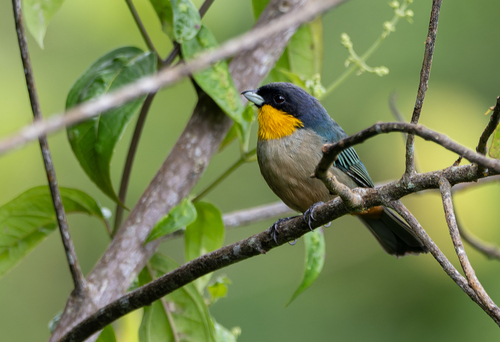 Yellow-throated Tanager
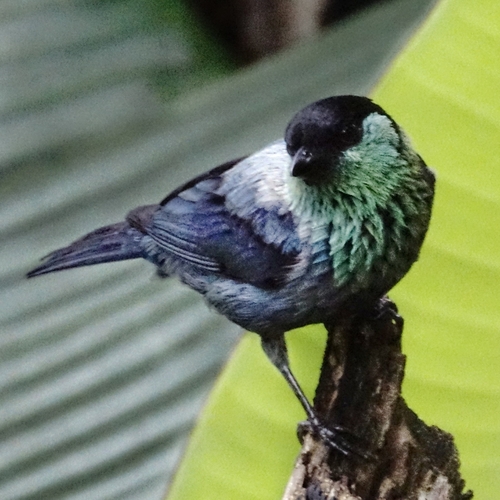 Black-capped Tanager
In short
The most reliable field mark to separate Yellow-throated Tanager from Black-capped Tanager is the presence of a bright yellow throat on the former, versus the shining aquamarine-green or green-scaled throat of the latter. Juvenile and female Black-capped Tanagers can be especially confusing, as they lack the male's black cap and have a generally greenish appearance, but they never show a yellow throat. In all ages and sexes, Black-capped Tanager shows a distinctive scaly or streaked effect on the throat and chest due to dark feather bases, while Yellow-throated Tanager has a more uniform yellow throat. Both species occur in similar Andean montane habitats, but subtle differences in structure and wing pattern can help in tricky cases, especially with immature birds.
Identification tips
- Yellow throat is diagnostic: Any bird with a bright yellow throat in this group is a Yellow-throated Tanager, regardless of age or sex. Black-capped Tanager never shows a yellow throat; its throat is green or aquamarine-green with a scaly or streaked look.
- Scaly/streaked throat and chest (Black-capped): Look for the distinctive scaly or streaked effect on the throat and chest of Black-capped Tanager, caused by dark feather bases. This is visible in all ages and sexes, but most striking in males.
- Black cap (male Black-capped): Adult male Black-capped Tanagers have a black crown extending to the lores, forehead, and upper nape, sharply set off from silvery bluish-grey upperparts. Yellow-throated Tanager lacks this cap.
- Female/immature confusion: Female and immature Black-capped Tanagers lack the black crown and are overall dull green with a green-scaled throat. They can be confused with other greenish tanagers, but never show a yellow throat.
- Upperwing pattern (Black-capped): In flight or at rest, Black-capped Tanager shows bluish-grey or greenish upperwing coverts, with primary coverts and tertials edged in blue or green. Juvenile males may show a pale blue edge to the primaries. Yellow-throated Tanager does not show these specific wing patterns.
- Size and bulk: Yellow-throated Tanager is heavier and may appear bulkier than Black-capped, which is lighter and slightly shorter. This is subtle and best used as supporting evidence.
- Habitat context: If the bird is seen in very open, bushy, or edge habitats within the mountains, Black-capped Tanager is more likely. Yellow-throated Tanager is more typical of dense montane forest.
- Behavior: Black-capped Tanagers may be seen hiding under branches or within bushes, often alone or in pairs. Yellow-throated Tanager is more likely to be active in mixed flocks in the canopy.
- Undertail coverts (Black-capped): Black-capped Tanager has undertail coverts with dark centers and broad white edges, a subtle feature but potentially useful at close range. No such pattern is described for Yellow-throated Tanager.
- Sex differences (Black-capped): Males are more contrasting with a black cap and silvery blue back; females are duller and greener. Both sexes always have a green or aquamarine-green throat, never yellow.
- Juvenile confusion: Juvenile Black-capped Tanagers resemble dull females, but may show a pale blue edge to the primaries. Yellow-throated Tanager juveniles are not detailed, but any yellow-throated bird is not a Black-capped.
- Song (Black-capped): If you hear a low-pitched, up-to-10-second song from a high perch, it is likely Black-capped Tanager. Yellow-throated Tanager's song is not described, so do not use this as sole evidence.
- Geographic overlap: Both species occur in Colombia and Ecuador. If in Venezuela, it is Black-capped; if in Peru, it is Yellow-throated.
- Comparison with similar species: Black-capped Tanager can resemble Silver-backed and Beryl-spangled Tanagers, but those have different throat and crown patterns. Yellow-throated Tanager is unlikely to be confused with these due to its yellow throat.
- Checklist approach: Always check throat color first, then look for crown color and scaly effect on the chest. Use habitat and behavior as supporting clues, and be cautious with dull females and immatures—throat color remains the best mark.
Size
Yellow-throated Tanager is heavier, with a body mass of about 26 g [wikidata], while Black-capped Tanager is smaller and lighter (18–20 g for adults, per Wikipedia). This difference is subtle in the field, but Yellow-throated Tanager may appear slightly bulkier and more robust, especially when seen side by side. Both are medium-sized tanagers, but Black-capped Tanager is a bit shorter in length (about 13 cm).
Plumage
-
Juvenile and Immature Birds: Black-capped Tanagers in juvenile and immature plumage resemble duller females, with greenish upperparts and a scaled green throat and chest. Juvenile males may show a pale blue edge to the primaries, but never a yellow throat. Yellow-throated Tanager juveniles are not described in detail in the sources, but the species is always characterized by a yellow throat, which is never present in Black-capped Tanager of any age.
-
Adult Males: Yellow-throated Tanager has a bright yellow throat, contrasting with darker blue or blackish upperparts (not detailed in these notes, but implied by the name and typical genus pattern). Black-capped Tanager males have a black crown, silvery bluish-grey upperparts, and a shining aquamarine-green or opalescent green throat and chest with a distinctive scaly appearance from dark feather bases. The rest of the underparts are dull greyish-blue.
-
Adult Females: Female Black-capped Tanagers lack the black cap, have a dusky crown edged in green (giving a slightly scaly look), and are overall duller and more greenish, with a green-scaled throat and chest. Female Yellow-throated Tanagers (not described in detail) would still show a yellow throat, which is diagnostic.
-
Upperwing Pattern: Black-capped Tanager has bluish-grey or greenish upperwing coverts with dusky or blackish primary coverts edged in blue or green, and tertials edged blue or green. These subtle contrasts are not likely to be diagnostic at a distance, but the overall impression is of a bird with some blue or green edging on otherwise dark wings. No distinctive upperwing pattern is described for Yellow-throated Tanager.
Behaviour
Black-capped Tanagers are often found alone or in pairs, foraging in open landscapes but frequently hiding under branches or within bushes. They may sing from high, sometimes exposed perches. Yellow-throated Tanagers' behavior is less detailed in the sources, but as a montane forest tanager, it is likely to be seen in mixed flocks within the canopy or subcanopy, often more active and less secretive than Black-capped. Both species can be seen foraging in the mid to upper levels of the forest, but Black-capped may be more likely to skulk or remain partially hidden.
Habitat
Both species are found in Andean montane forests of Colombia and Ecuador, with Yellow-throated Tanager also in Peru and Black-capped Tanager also in Venezuela. Yellow-throated Tanager prefers subtropical or tropical moist montane forests, while Black-capped Tanager is noted for using open landscapes within the mountains, sometimes venturing into more open or edge habitats and hiding in bushes. Overlap is substantial, but Black-capped may be more likely at forest edge or in semi-open areas.
Voice
Black-capped Tanager is noted for singing frequently, often from high and sometimes exposed perches. Its song is up to ten seconds long and low-pitched. No vocalization details are provided for Yellow-throated Tanager in the sources, so song is not a reliable separation unless Black-capped is heard singing.
Yellow-throated Tanager · Black-capped Tanager · My Tricky Birds