Birdr

Bay-breasted Warbler vs Chestnut-sided Warbler

Setophaga castanea versus Setophaga pensylvanica

Play a quiz with Bay-breasted Warbler and Chestnut-sided Warbler
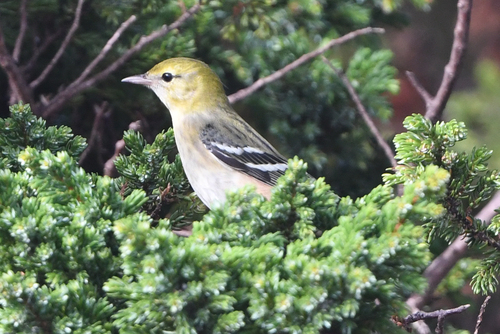
Bay-breasted Warbler (Setophaga castanea) Bay-breasted Warbler
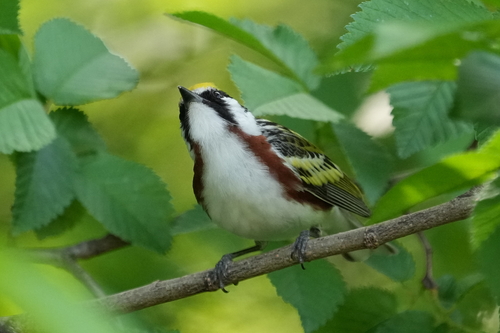
Chestnut-sided Warbler (Setophaga pensylvanica) Chestnut-sided Warbler

Media

Loading…

In short

The Bay-breasted Warbler and Chestnut-sided Warbler can be distinguished by their plumage and habitat preferences. The Bay-breasted Warbler has a more uniform appearance with distinct bay-colored flanks, while the Chestnut-sided Warbler is notable for its bold chestnut sides and contrasting yellow crown. Both species are insectivorous but have different breeding habitats.

Identification tips

Size

Both species are similar in size, typical of small warblers.

Plumage

In breeding plumage, the Bay-breasted Warbler has a chestnut crown and flanks with a buffy underbelly, while the Chestnut-sided Warbler features bold chestnut sides, a yellow crown, and a white underbelly. Nonbreeding Bay-breasted Warblers can resemble Blackpoll Warblers, making them difficult to distinguish.

Behaviour

Both species are active foragers, but the Chestnut-sided Warbler often forages with its tail cocked, which can be a helpful behavioral cue.

Habitat

The Bay-breasted Warbler breeds in boreal coniferous forests, primarily in northern spruce forests, while the Chestnut-sided Warbler prefers deciduous and mixed woodlands with dense undergrowth.

Voice

The Chestnut-sided Warbler's song is often described as 'please, please, pleased to meet you,' which is distinct from the Bay-breasted Warbler's less well-documented song.

Submit a better description

Use the same sections as the comparison. Your text is published immediately.

The Bay-breasted Warbler and Chestnut-sided Warbler can be distinguished by their plumage and habitat preferences. The Bay-breasted Warbler has a more uniform appearance with distinct bay-colored flanks, while the Chestnut-sided Warbler is notable for its bold chestnut sides and contrasting yellow crown. Both species are insectivorous but have different breeding habitats.

  • Breeding plumage: Look for the bay-colored flanks in Bay-breasted Warblers and the chestnut sides with a yellow crown in Chestnut-sided Warblers.
  • Nonbreeding plumage: Bay-breasted Warblers can resemble Blackpoll Warblers; focus on subtle plumage differences.
  • Behavior: Note the tail-cocking behavior of the Chestnut-sided Warbler.
  • Habitat: Consider the habitat; Bay-breasted Warblers prefer coniferous forests, while Chestnut-sided Warblers are found in deciduous areas.

Both species are similar in size, typical of small warblers.

In breeding plumage, the Bay-breasted Warbler has a chestnut crown and flanks with a buffy underbelly, while the Chestnut-sided Warbler features bold chestnut sides, a yellow crown, and a white underbelly. Nonbreeding Bay-breasted Warblers can resemble Blackpoll Warblers, making them difficult to distinguish.

Both species are active foragers, but the Chestnut-sided Warbler often forages with its tail cocked, which can be a helpful behavioral cue.

The Bay-breasted Warbler breeds in boreal coniferous forests, primarily in northern spruce forests, while the Chestnut-sided Warbler prefers deciduous and mixed woodlands with dense undergrowth.

The Chestnut-sided Warbler's song is often described as 'please, please, pleased to meet you,' which is distinct from the Bay-breasted Warbler's less well-documented song.

Discard your changes?

You have unsaved edits. If you leave now, those changes will be lost.

Bay-breasted Warbler · Chestnut-sided Warbler · My Tricky Birds