
White-barred Piculet vs Mottled Piculet
Picumnus cirratus versus Picumnus nebulosus
Play a quiz with White-barred Piculet and Mottled Piculet
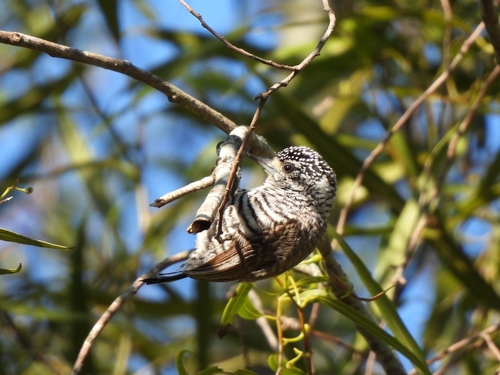 White-barred Piculet
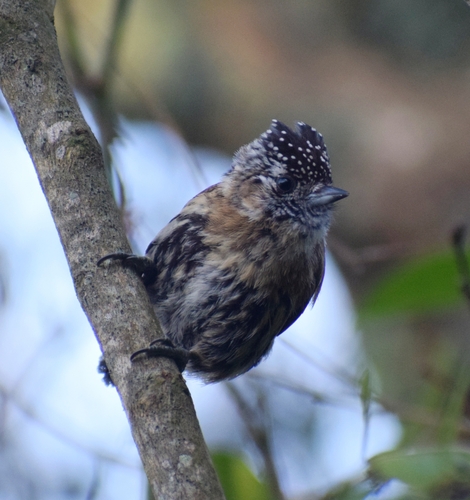 Mottled Piculet
In short
Juvenile White-barred Piculets show heavier barring above and below, while juvenile Mottled Piculets have a dull brown crown with pale streaks and less contrast overall. For adults, focus on the underparts: White-barred Piculet is boldly barred white and black below, while Mottled Piculet has a buffy, streaked belly and flanks. Both species share a black cap with a red forehead patch in males, but the face and upperpart tones differ subtly. In overlapping range, careful attention to underpart pattern and face color is the most reliable field separation.
Identification tips
- Juvenile upperparts: Juvenile White-barred Piculets show obvious barring on the upperparts and heavier barring below, while juvenile Mottled Piculets have a dull brown crown with pale streaks and less distinct barring. Use this for birds lacking adult cap pattern.
- Adult underpart pattern: White-barred Piculet (all subspecies) shows bold black barring on white underparts, sometimes with a buff tinge. Mottled Piculet has buffish brown underparts with dark streaks or wide blackish streaks on the flanks, not crisp barring. This is the single best field mark for adults.
- Face color: White-barred Piculet's face is dark buff-brown with faint blackish bars and a white stripe behind the eye (in nominate), while Mottled Piculet's face is darker olive-brown with some white but lacks a clear post-ocular stripe. Subspecies of White-barred may lack the white stripe, so this is supportive but not definitive.
- Upperpart tone: White-barred Piculet has dull brownish or grayish upperparts (sometimes faintly barred), while Mottled Piculet is warmer olive-brown with a buff or rusty tinge. This is subtle and best used in good light.
- Tail pattern: Both have dark tails with white on the inner webs of the innermost feathers and white marks on the outer pairs, but Mottled Piculet's tail is black (not brown) and the white is a streak on the outer web of the outer three pairs. This is a minor point but may help in close views.
- Cap pattern (adults): Males of both species have a black cap with a red forehead patch and white spots elsewhere; females lack the red. This is not a separator between these two.
- Subspecies confusion: Some White-barred Piculet subspecies (e.g., P. c. tucumanus, P. c. pilcomayensis) have less red on the crown and more grayish or buffy tones, which can resemble Mottled Piculet in color but not in underpart pattern.
- Size and structure: Both species are nearly identical in size and structure. Do not rely on size or bill shape for separation.
- Vocalizations: If you hear a repetitive 'seep' or 'cheep' or a cricket-like alarm whistle, you are likely hearing Mottled Piculet. Lack of vocalization is not diagnostic.
- Range: If outside Argentina, Brazil, or Uruguay, you are almost certainly seeing White-barred Piculet. Within the overlap zone, use plumage.
- Sex differences: In both species, only males have red on the forehead; females have white spots across the cap. This does not separate the two species but helps with sexing.
- Perched vs. in flight: Most field marks are visible on perched birds. In flight, look for the extent and pattern of underpart barring vs. streaking, and any visible face pattern.
- Lighting and wear: Faint barring or streaking can be hard to judge in poor light or on worn birds. Focus on the boldness and type of underpart markings.
- Immature confusion: Young birds of both species are duller, but only White-barred shows strong barring above and below in juveniles.
- Drumming: If you observe irregular drumming, especially on bamboo, this supports Mottled Piculet, but absence of drumming is not diagnostic.
Size
Both species are very similar in size, with White-barred Piculet about 10 cm long and Mottled Piculet 10–11 cm. Mottled Piculet is slightly heavier on average (11–12 g) than most White-barred Piculets (6.3–12 g), but this difference is not visible in the field. Structure, bill shape, and jizz are not described as different in the available sources.
Plumage
-
Juveniles: Juvenile White-barred Piculets are overall duller and darker than adults, with an unspotted crown, more obvious barring on the upperparts, and heavier barring on the underparts. Juvenile Mottled Piculets are also duller than adults but have a dull brown crown with pale buffish streaks, lacking the strong barring of juvenile White-barred.
-
Adults: Both males have a black cap with a red forehead patch and white spots elsewhere; females lack the red. White-barred Piculet has a mostly dark buff-brown face with faint blackish bars and a white post-ocular stripe (in nominate), dull brownish upperparts (sometimes faintly barred), and underparts that are white with bold black barring and a buff tinge. Mottled Piculet has a darker olive-brown face with some white, warm olive-brown upperparts with a buff or rusty tinge, and underparts that are buffish brown with dark streaks or wide blackish streaks on the flanks, not the crisp barring of White-barred. The tail pattern is similar: both have mostly dark tails with white on the inner webs of the innermost feathers and white patches or streaks on the outer pairs, but Mottled Piculet's tail is black (not brown) and the white is on the outer web of the outer three pairs.
-
Subspecies variation: White-barred Piculet shows marked subspecific variation in face and underpart barring, but always has more barring below than Mottled Piculet. Some subspecies (e.g., P. c. tucumanus, P. c. pilcomayensis) have reduced red on the crown and more grayish or buffy tones, which can overlap with Mottled Piculet's tones but not its streaked underparts.
Behaviour
No behavioral differences are described between these two species in the available sources. Both are small, active woodpeckers likely to be seen foraging on small branches or bamboo, but this is not diagnostic.
Habitat
Both species overlap in Argentina, Brazil, and Uruguay, but White-barred Piculet has a broader range extending into Bolivia, French Guiana, Guyana, and Paraguay. Habitat preferences are not detailed in the notes, so context is not a reliable separator where their ranges overlap.
Voice
Only Mottled Piculet's voice is described: it gives a repetitive 'seep' or 'cheep', sometimes forming a brief trill, and a shrill, cricket-like alarm whistle. It also drums irregularly, especially on bamboo. No vocal details are provided for White-barred Piculet, so voice is not a reliable separator unless you hear the described calls or drumming of Mottled Piculet.